
Can novel coronavirus stay in the body for years?

Can novel coronavirus stay in the body for years? muTu's Note - Read and Learn Chinese in 5 Minutes
Can novel coronavirus stay in the body for years?

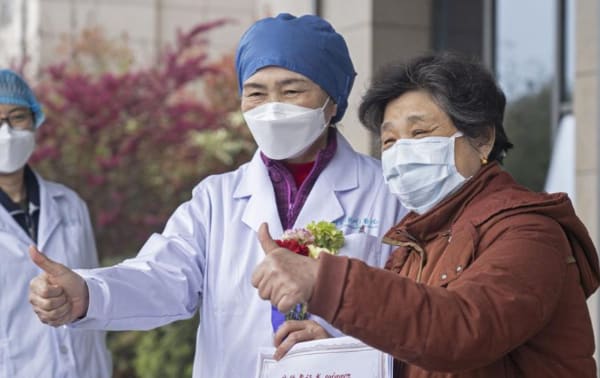
Li Lanjuan, left, a renowned Chinese epidemiologist, poses for a photo with the 600th cured patient of COVID-19 at the east branch of Renmin Hospital of Wuhan University in Wuhan, Hubei Province, on March 16, 2020.

A rumor claims the novel coronavirus, the pathogen that causes COVID-19, can remain in the body of an infected person for years and requires lifelong medication, as with the infection of hepatitis B, where a patient is a chronic carrier of the virus.

The misunderstanding was debunked by Hou Jinlin, an infectious disease physician with Nanfang Hospital in Guangzhou.

Hou said COVID-19, an acute infectious disease, is totally different from hepatitis B, which is a chronic disease. For hepatitis B patients, antibodies are constantly generated to neutralize the viruses.

If antibodies cannot be detected, it is because viruses are constantly replicating and antibodies are generated to neutralize them. Otherwise, it indicates viruses have been deactivated.

For most people, medicine treatment can’t cure chronic hepatitis B, only suppressing the replication of the virus. Therefore, most people who start treatment must continue it for life, according to information published by the World Health Organization.

COVID-19 is an acute respiratory disease, and the virus won’t stay hidden for a lifetime in a person’s body once the disease has been cured, Hou said. The novel coronavirus is usually cleared within 14 days if a patient has a strong immune system, and then antibodies will be detected.

Hou added, however, a small amount of the novel coronavirus can still replicate after the antibody has been produced in a person’s body, which means patients could still spread the virus to others. Therefore, the production of antibodies shouldn’t be regarded as a standard for a patient to get discharged from the hospital.

Patients in China can get discharged after two consecutive negative nucleic acid tests, taken at least 24 hours apart, and by exhibiting indications of clinical recovery, including body temperature, respiratory symptoms and CT lung screening, according to the latest version of diagnostic guidance released by the National Health Commission.


The related posts:

What is COVID-19?

How protect yourself from COVID? Share this to your friends, Please!

Lastest Number of COVID cases(novel coronavirus)

Can coronavirus be spread through the air?

Can a COVID-19 patient recover without treatment?

Can the COVID-19 virus spread through drinking water?


Tips: There are Chinese translations here, but they are hidden. you need to leave your own translation or other content in the comment box and Refresh to view it.


from WordPress https://ift.tt/3edP2Cu

Comments

Popular posts from this blog

What pets do you like? Look here!

What pets do you like? Look here! muTu Note - Learn Chinese with Chinese Girl Nowadays, many people would like to keep pets as their companions. There are so many pet shops, pet foods, and even pet clinics around us. 现在,很多人喜欢喂养宠物作为自己的伙伴。我们周围有许多宠物店、宠物食品甚至宠物医院。对于那些宠物的饲养者来说,宠物是他们最好的朋友并且能给他们带来无尽的乐趣。 然而,宠物也会给他人带来麻烦。有些人抱怨他们的生活被如此多的狗吠声所骚扰;小猫小狗还很可能伤及孩子,许多人认为喂养宠物应该受到限制。 就我而言,宠物是我们的朋友,我们应该善待他们,然而我们也应估计他人的感受。我希望在我们享受宠物给我们带来的快乐的同时,他人仍然能够拥有宁静祥和的生活。 Nowadays, many people would like to keep pets as their companions. There are so many pet shops, pet foods, and even pet clinics around us. For pet owners, pets are their favorite friends and can bring them countless pleasures. However, pets can bring problems to others as well. Some people complain that their lives are disturbed by so many dogs’ barking; some children even get hurt by the dogs or cats. Many people think that pet-keeping should be limited. As far as I am concerned, pets are our friends so we should treat them kindly. Yet we shou...

我的诺言 My Promise

我的诺言——My Promise——wǒ de nuò yán My Promise Pinyin: zǎo shàng , wǒ mā mā wèn wǒ néng bù néng sǎo yī xià dì yīn wéi tā yǒu shì yào wài chū yī tiān 。 wǒ dā yīng le , jiù jì xù wán diàn nǎo yóu xì 。 shí jiān guò de hěn kuài , wǒ gǎn dào jī ě shí yǐ jīng tiān hēi le 。 tū rán , wǒ xiǎng qǐ lái wǒ yào zuò jiā wù zhè jiàn shì 。 wǒ bì xū xìn shǒu wǒ de nuò yán 。 yīn cǐ wǒ mǎ shàng kāi gōng le , hěn kuài jiù wán chéng le rèn wù 。

Panda in Beijing Zoo suffers baldness, What Happened?!

Panda in Beijing Zoo suffers baldness, What Happened?! muTu Note - Learn Chinese with Chinese Girl There are no small matters when it comes to pandas(大熊猫,dà xióng māo) in China, even if it is a tonsure on a panda’s head. Panda in Beijing Zoo suffers baldness, What Happened?! Panda in Beijing Zoo suffers baldness, What Happened?! Chinese netizens flooded on to social media platforms on Tuesday to express worries as media reported that a 3-year-old panda named Fu Xing(福星) in the Beijing Zoo(北京动物园,běi jīng dòng wù yuán) is suffering from a tonsure on his head for an unclear reason(不明原因,bù míng yuán yīn). The tonsure is about the size of two one-yuan coins(硬币,yìng bì), according to a video on The Beijing News Sina Weibo account. The diameter(直径,zhí jìng) of a one-yuan coin is 25 millimeters. The zoo has used medicines on the panda, and new hair started to grow again. Zookeepers(动物管理员,dòng wù guǎn lǐ yuán) also arranged two experts(专家,zhuān jiā) to further check the problem, the...