
Wuhan’s 1,800-year-old Yellow Crane Tower to launch night tours

Wuhan’s 1,800-year-old Yellow Crane Tower to launch night tours muTu Note - Learn Chinese with Chinese Girl

Wuhan’s iconic Yellow Crane Tower(黄鹤楼,huáng hè lóu) will offer evening tours as the city looks to boost its nighttime economy(夜间经济,yè jiān jīng jì) and tourism after bringing the COVID-19 epidemic under control.
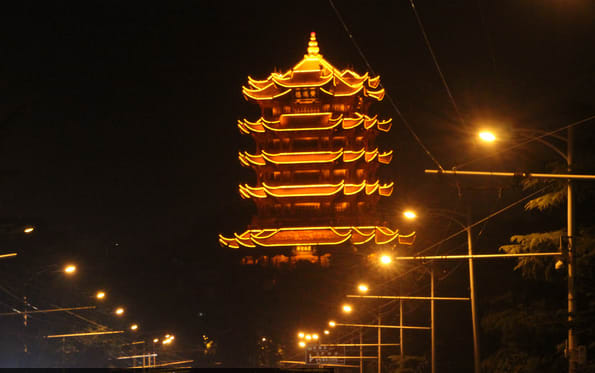
Wuhan's 1,800-year-old Yellow Crane Tower to launch night tours

Night tours will be available from October 1 to 8 during the National Day(国庆节,guó qìng jié) and Mid-Autumn Festival(中秋节,zhōng qiū jié) holidays, which usually see a spike in domestic travel.

Visitors can ascend the tower to appreciate the night views(夜景,yè jǐng) as well as a light show(灯光秀,dēng guāng xiù), which will be staged at the historic building and along the Yangtze River(长江,cháng jiāng) every night during the period, according to organizers.

The show, entitled “Ascending the Yellow Crane Tower at Night,” will adopt advanced techniques to incorporate multimedia(多媒体,duō méi tǐ) elements, such as lights, sounds, and animated projections, with live performances(现场表演,xiàn chǎng biǎo yǎn) of classic arts.

“[The show] is offering visitors an immersive experience(沉浸式体验,chén jìn shì tǐ yàn) and a unique cultural landscape of the ancient legacy,” said the show’s director Liu Fei.

Perched on Snake Hill beside the Yangtze River, the 1,800-year-old tower often appeared in ancient Chinese literary works(文学作品,wén xué zuò pǐn) and is one of the Four Great Towers(四大名楼,sì dà míng lóu) in China. It has been destroyed and rebuilt(重建,chóng jiàn) many times in its long history, and was most recently renovated in 1985.

The ancient building is among the major tourist attractions(旅游景点,lǚ yóu jǐng diǎn) in Wuhan, capital of central China’s Hubei province, that have scrapped tickets for domestic visitors as a token of gratitude for nationwide assistance(援助,yuán zhù) during the city’s fight with COVID-19.

Hubei last month announced it would open its key scenic spots to domestic visitors free of charge until the end of 2020, aiming to revive(振兴,zhèn xīng) the province’s virus-hit tourism industry.


from WordPress https://ift.tt/31za75q

Comments

Popular posts from this blog

我的诺言 My Promise

我的诺言——My Promise——wǒ de nuò yán My Promise Pinyin: zǎo shàng , wǒ mā mā wèn wǒ néng bù néng sǎo yī xià dì yīn wéi tā yǒu shì yào wài chū yī tiān 。 wǒ dā yīng le , jiù jì xù wán diàn nǎo yóu xì 。 shí jiān guò de hěn kuài , wǒ gǎn dào jī ě shí yǐ jīng tiān hēi le 。 tū rán , wǒ xiǎng qǐ lái wǒ yào zuò jiā wù zhè jiàn shì 。 wǒ bì xū xìn shǒu wǒ de nuò yán 。 yīn cǐ wǒ mǎ shàng kāi gōng le , hěn kuài jiù wán chéng le rèn wù 。

What is your favorite Chinese dish for Spring Festival?

What is your favorite Chinese dish for Spring Festival? muTu Note - Learn Chinese with Chinese Girl In China, there are many delicious food , especially during the Spring Festival. What is your favorite dish for Chinese Spring Festival? Dumplings Dumplings Dumplings are a very common dish for northern China, symbolizing reunion and fortune. Rice dumplings Rice dumplings Rice dumplings are made from glutinous rice flour. The fillings can vary from region to region. The round shape of the rice dumplings symbolizes “reunion”. Fish Fish “Fish” in Chinese sounds similar to the character for “prosperity”, symbolizing an abundant and comfortable life. Most families would have fish on their New Year’s Eve dinner. Lion-head meatballs Lion-head meatballs One of the representative dishes of Huaiyang cuisine, it has a lucky connotation from its name. Poon choi Poon choi A regular dish in southern China, the magnificent and auspicious poon choi contains up to 20 luxury in...

Panda in Beijing Zoo suffers baldness, What Happened?!

Panda in Beijing Zoo suffers baldness, What Happened?! muTu Note - Learn Chinese with Chinese Girl There are no small matters when it comes to pandas(大熊猫,dà xióng māo) in China, even if it is a tonsure on a panda’s head. Panda in Beijing Zoo suffers baldness, What Happened?! Panda in Beijing Zoo suffers baldness, What Happened?! Chinese netizens flooded on to social media platforms on Tuesday to express worries as media reported that a 3-year-old panda named Fu Xing(福星) in the Beijing Zoo(北京动物园,běi jīng dòng wù yuán) is suffering from a tonsure on his head for an unclear reason(不明原因,bù míng yuán yīn). The tonsure is about the size of two one-yuan coins(硬币,yìng bì), according to a video on The Beijing News Sina Weibo account. The diameter(直径,zhí jìng) of a one-yuan coin is 25 millimeters. The zoo has used medicines on the panda, and new hair started to grow again. Zookeepers(动物管理员,dòng wù guǎn lǐ yuán) also arranged two experts(专家,zhuān jiā) to further check the problem, the...